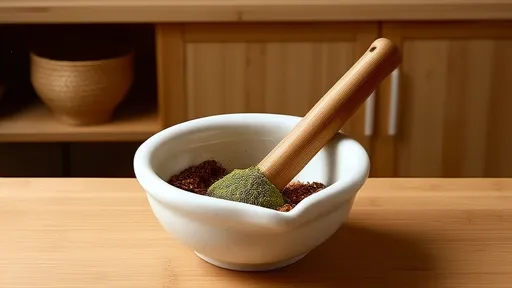
In the quiet corners of kitchens across Japan, a distinctive piece of ceramicware holds a place of profound respect. The suribachi, a ridged grinding bowl, and its wooden pestle, the surikogi, are not merely tools; they are the guardians of flavor, the keepers of aroma, and the bridge to a culinary tradition where patience is the most crucial ingredient. While the modern world races towards convenience with pre-ground spices and pastes available at the flick of a wrist, a dedicated few understand that the true soul of a dish is often unlocked not by a blade, but by the gentle, crushing friction of stone on stone.
The suribachi itself is a work of functional art. Traditionally made from pottery, its interior is etched with a series of fine, unglazed ridges called kushi-no-me, or "comb's teeth." This textured surface is the engine of the device, designed to grip, tear, and pulverize rather than simply cut. Its partner, the surikogi, is typically crafted from unfinished wood, often from the Japanese pepper tree (sanshō) or other hardwoods, chosen for their durability and neutral scent that won't taint the ingredients. This pairing is a study in purposeful design, a technology refined over centuries specifically for the task of releasing the volatile oils and complex compounds locked within seeds, nuts, and dried plants.
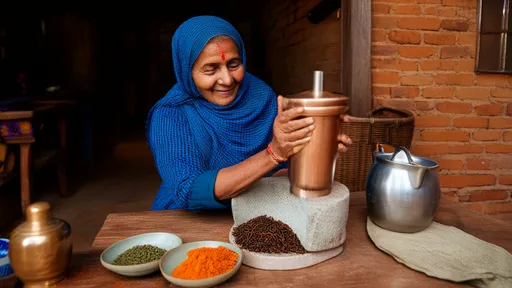
To witness the grinding of whole spices in a suribachi is to observe a transformation. Take, for instance, a handful of coriander seeds. In their whole form, they are hard, spherical, and give off only a faint, musty scent. As the surikogi is pressed and rotated against the ridges, a symphony of cracks and pops begins. Almost immediately, the air is flooded with a bright, citrusy, and profoundly aromatic fragrance that is utterly absent from even the highest-quality pre-ground jar. This is because flavor is not a static entity; it is a volatile cocktail of essential oils and chemical compounds that begin to degrade the moment they are exposed to air and light.
The act of grinding creates friction and localized heat, but it is a gentle warmth, a far cry from the violent, high-speed assault of a blade-based electric grinder. This mechanical action is crucial. It shears and crushes the cellular walls of the spice, forcing these precious oils to the surface without generating enough heat to scorch or cook them. The result is a paste or powder that is vibrantly alive, its flavor profile complete and nuanced. Each turn of the wrist coaxes out layers of complexity—top notes, heart notes, and base notes—that pre-ground spices lost weeks or months ago on a factory shelf.
Nowhere is this difference more stark and celebrated than in the preparation of goma (sesame). Sesame seeds are tiny oil bombs, their flavor potential immense but tightly sealed within a tough, fibrous hull. Toasting the seeds is the first critical step, awakening a deep, nutty aroma. But the true magic happens in the suribachi. Grinding toasted sesame seeds is a rhythmic, almost meditative process. The initial crush yields a coarse, dry meal. But as one continues, the released oils begin to bind the particles together. The texture evolves from sandy to clumpy, then finally to a smooth, lustrous, and incredibly fragrant paste known as nerigoma.
The flavor of freshly ground nerigoma is a revelation. It is rich and nutty, yes, but also surprisingly sweet and complex, with a depth that lingers on the palate. It is the irreplaceable heart of dishes like goma-ae, where vegetables are dressed in this exquisite paste. Compare this to store-bought tahini or pre-ground sesame powder. These products often taste flat, one-dimensional, and sometimes slightly bitter or rancid from oxidation. They lack the creamy, unctuous texture and the vibrant top notes that define the fresh version. The suribachi doesn't just make sesame paste; it coaxes out the very soul of the seed.
This principle extends across the spice spectrum. Black peppercorns ground at the last minute offer a sharp, piney, and citrusy punch that pre-ground pepper can only dream of. Cumin seeds, when toasted and freshly crushed, release a warm, earthy, and slightly smoky aroma that forms the backbone of countless curries and stews, a flavor that its powdered counterpart retains only a ghost of. Mustard seeds, ground with a little liquid, initiate an enzymatic reaction that creates their characteristic heat—a reaction that is long spent in prepared mustards. The suribachi allows the cook to harness these reactions at their peak.
Beyond the sheer power of flavor, the process itself offers an intangible benefit: a connection to the food. Grinding spices by hand is an act of mindfulness. It demands attention to sound, smell, and texture. It forces a slowdown, a moment of focus amidst the chaos of cooking. This ritualistic aspect is deeply embedded in Japanese food culture, where the preparation is as valued as the consumption. It is a practice in intentionality, a reminder that the finest results cannot be rushed.
In a culinary landscape dominated by efficiency, the suribachi and surikogi stand as a testament to the philosophy that some things are worth the time and effort. They represent a choice to prioritize depth of flavor over convenience, to engage directly with ingredients, and to participate in the alchemy of cooking from its most fundamental stage. The difference they make is not a subtle one; it is the chasm between a dish that is merely seasoned and a dish that is truly alive with aroma and taste. It is the difference between hearing a song played on a low-quality recording and hearing it performed live, in the same room, with every vibration felt in your bones. For those who seek to elevate their cooking from the ordinary to the extraordinary, the path is clear: embrace the grind.

By /Aug 20, 2025
By /Aug 20, 2025
By /Aug 20, 2025

By /Aug 20, 2025

By /Aug 20, 2025

By /Aug 20, 2025

By /Aug 20, 2025
By /Aug 20, 2025

By /Aug 20, 2025
By /Aug 20, 2025
By /Aug 20, 2025
By /Aug 20, 2025
By /Aug 20, 2025

By /Aug 20, 2025

By /Aug 20, 2025

By /Aug 20, 2025
By /Aug 20, 2025
By /Aug 20, 2025

By /Aug 20, 2025
By /Aug 20, 2025
