In the misty mountains of Yunnan, where ancient tea trees whisper secrets to the clouds, a profound alchemy unfolds—one that transcends mere blending and enters the realm of artistry. The craft of Pu-erh tea blending, particularly the harmonious marriage of leaves from different years and diverse terroirs, is not just a technique; it is a narrative woven with patience, intuition, and a deep reverence for nature’s nuances. This is where time and earth converge in a cup, telling stories of rain, soil, and seasons.
At its heart, Pu-erh blending is an exercise in balance—a pursuit of complexity without chaos. Master blenders, often with decades of experience, approach their work like composers orchestrating a symphony. Each tea, whether raw (sheng) or ripe (shou), carries its own voice: a young tea might sing with vibrant, astringent highs, while an aged one hums with deep, mellow bass notes. Similarly, leaves from Bulang offer bold, bitter intensity; those from Yiwu exude floral delicacy; and Menghai contributions bring sturdy, earthy foundations. The blender’s genius lies in listening to these voices and arranging them into a cohesive, evolving melody.
Terroir, that elusive fingerprint of place, imprints itself unmistakably on Pu-erh. The mineral-rich soils of Lincang, the humid microclimates of Xishuangbanna, the altitude-kissed slopes of Pu’er City—each locale bestows unique characteristics. Blenders harness these differences, not to homogenize, but to highlight contrasts that elevate the whole. A touch of Bulang’s robustness might anchor the ethereal sweetness of Yiwu, while a hint of Menghai’s fermentation-friendly leaves can accelerate the aging potential of a blend. It is a dance of opposites: youth and maturity, strength and subtlety, all seeking equilibrium.
Time, however, is the silent partner in this dance. Unlike other teas, Pu-erh is alive, evolving in the cup and in the cellar. Blending across vintages is not merely about mixing old and new; it is about forecasting transformation. A master blender anticipates how a fiery young tea will soften over decades, or how a settled aged tea will enliven when paired with something fresher. This temporal layering creates dimensions that unfold sip after sip, year after year—a quality that makes each blend not just a beverage, but a living archive.
The process itself is intimate and iterative. Blenders taste incessantly, sipping infusions side-by-side, noting how textures clash or harmonize, how aftertastes linger or fade. They might trial dozens of prototypes before settling on a recipe, often guided by intuition honed through years of sensory memory. There are no formulas, only principles: seek balance, respect origin, and honor the tea’s destiny. The goal is a blend that is greater than the sum of its parts—one that offers immediate pleasure but also promises revelation with age.
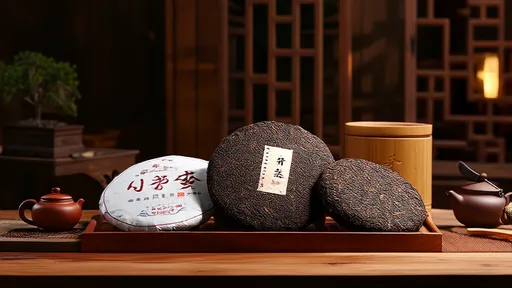
Yet, this art faces modern pressures. As demand for Pu-erh surges, some producers prioritize consistency over character, sacrificing regional distinctiveness for uniform taste. True blenders resist this, arguing that the soul of Pu-erh lies in its diversity. They champion small-batch creations that tell specific stories—a 2015 Yiwu blended with a 1990s Bulang reserve, for instance, might evoke a dialogue between generations. These blends are not commodities; they are cultural statements, preserving heritage in every cake and brick.
For the drinker, experiencing a well-crafted blend is akin to time travel. The first sip might burst with the brightness of youth—notes of apricot and fresh hay—then deepen into the leather, spice, and damp earth of maturity. The finish lingers, a testament to the blender’s skill in weaving timelines. It is a reminder that Pu-erh is never static; it is a journey in a cup, inviting contemplation not just of flavor, but of patience, place, and the passage of years.
In the end, the fusion of years and regions in Pu-erh blending is more than craft—it is philosophy. It teaches that contrast need not mean conflict, that time can be both preserved and progressed, and that true harmony arises from diversity. Each blend is a tribute to the land and the years, a liquid testament to the idea that some things, like great tea, are worth waiting for and worth weaving together with care.
By /Aug 20, 2025
By /Aug 20, 2025
By /Aug 20, 2025

By /Aug 20, 2025

By /Aug 20, 2025
By /Aug 20, 2025
By /Aug 20, 2025
By /Aug 20, 2025

By /Aug 20, 2025

By /Aug 20, 2025
By /Aug 20, 2025
By /Aug 20, 2025

By /Aug 20, 2025

By /Aug 20, 2025

By /Aug 20, 2025
By /Aug 20, 2025
By /Aug 20, 2025

By /Aug 20, 2025

By /Aug 20, 2025
By /Aug 20, 2025
